“How Celiac Disease Is Diagnosed: Blood Tests, Biopsy, and Why You Keep Eating Gluten


Portriat of Staci Leibson

Published October 10, 2026

Staci Leibson – Life Coach at The Celiac Shift

How Is Celiac Disease Diagnosed?

Celiac disease is usually diagnosed in two steps: a blood test that looks for antibodies your body makes in reaction to gluten, followed in most cases by a small intestine biopsy taken during an endoscopy. Keep eating gluten until all testing is finished, because going gluten-free first can make results look falsely normal.

If you have noticed possible signs of celiac disease in yourself or your child, our guide to celiac disease symptoms and early warning signs explains what to look for. This page picks up from there and walks through what testing actually involves, step by step.

Why You Need to Keep Eating Gluten Before Testing

Celiac tests do not look for gluten itself. They look for your body’s reaction to gluten: the antibodies your immune system makes and the damage it does to the lining of your small intestine. When you stop eating gluten, those antibodies start to fade, and the intestine begins to heal. That is good for your health, but it can make a test come back normal even when you do have celiac disease.

That is why the National Institutes of Health advises against starting a gluten-free diet before testing. Keep eating your usual foods with gluten until your doctor says all testing, including any biopsy, is complete.

Already cut back on gluten? Tell your doctor before you add it back. Do not restart gluten on your own to “get ready” for a test. Your doctor can decide whether you need a supervised gluten challenge, explained further down this page.

Step 1: The Celiac Blood Test

For most children and adults, testing starts with a simple blood draw. The main test is called tTG-IgA (tissue transglutaminase IgA). It measures an antibody that is usually high in people with celiac disease who are eating gluten.

According to the Celiac Disease Foundation, the tTG-IgA test is positive in about 93 percent of people with celiac disease who eat gluten, and negative in about 96 percent of people who do not have it. That makes it a strong first step, but not a final answer.

Why doctors also check your total IgA

Some people naturally make very little IgA, the type of antibody the main test measures. This is called IgA deficiency, and it is more common in people with celiac disease. If your IgA is low, the tTG-IgA test can come back falsely normal. So doctors usually order a total IgA test at the same time. If it is low, they switch to tests that measure a different antibody type, IgG.

The celiac blood tests at a glance

Test What it checks When it is used
tTG-IgA The main celiac antibody First test for most children and adults
Total IgA Whether your body makes enough IgA for the main test to work Usually ordered alongside tTG-IgA
EMA-IgA (endomysial antibody) A second celiac antibody that is very rarely positive without celiac disease To double-check results or in hard-to-read cases
DGP (deamidated gliadin peptide) IgA and IgG Antibodies to broken-down gluten proteins For people with low IgA, and often added for children about age 2 and younger
tTG-IgG The main antibody, measured as IgG instead of IgA For people with low IgA

A positive blood test strongly suggests celiac disease but does not confirm it on its own. False positives can happen, especially in people with other autoimmune conditions such as type 1 diabetes or thyroid disease. That is why the next step is usually a look at the intestine itself.

Step 2: The Small Intestine Biopsy

If your blood test is positive, or your doctor strongly suspects celiac disease even with a normal blood test, you will usually be referred to a gastroenterologist, a doctor who specializes in the digestive system. The American College of Gastroenterology recommends confirming the diagnosis with an upper endoscopy and several small biopsies in both children and adults.

What happens during an endoscopy

  • You are usually given medicine to help you relax or sleep. It is typically an outpatient procedure, meaning you go home the same day.
  • The doctor guides a thin, flexible tube with a tiny camera through your mouth, past your stomach, and into the first part of the small intestine.
  • Using a small tool passed through the tube, the doctor takes several tiny tissue samples from different spots.
  • A specialist called a pathologist looks at the samples under a microscope for signs of celiac damage, especially flattened villi. Villi are tiny, finger-like bumps that line the intestine and absorb nutrients from food.

You still need to be eating gluten on the day of your endoscopy. Stopping between the blood test and the biopsy can make the biopsy look normal.

A note about the skin rash

If you have the itchy, blistering rash linked to celiac disease, called dermatitis herpetiformis, a doctor may confirm the diagnosis with a small skin biopsy instead.

Can Celiac Disease Be Diagnosed Without a Biopsy?

Sometimes, in children. When a child’s tTG-IgA level is very high, at least 10 times the lab’s normal limit, and a second, separate blood sample is positive for EMA, some pediatric gastroenterologists may confirm celiac disease without an endoscopy. This approach comes from European pediatric guidelines, and the authors of the 2023 American College of Gastroenterology guideline support it for children with very high levels.

For adults in the United States, a biopsy is still the standard way to confirm the diagnosis. Some newer European guidelines allow blood tests alone for certain adults, so ask your gastroenterologist which approach fits your situation.

What Genetic Testing Can and Cannot Tell You

Almost everyone with celiac disease carries one or both of two gene types called HLA-DQ2 and HLA-DQ8. A genetic test can check for them using a blood sample or a cheek swab.

  • If you do not carry either gene, you are very unlikely to have or ever develop celiac disease. This can save you from future testing.
  • If you do carry one, it does not mean you have celiac disease. The Celiac Disease Foundation notes that up to 25 to 30 percent of people carry these genes, and most never develop celiac disease.

Unlike the blood test and biopsy, a genetic test works whether or not you are eating gluten, and it can be done at any age. That makes it especially useful for people who have already gone gluten-free, for unclear test results, and for family members. Genetic testing can cost several hundred dollars, so check with your insurance plan first.

Already Gluten-Free? What a Gluten Challenge Involves

If you stopped eating gluten before being tested, your doctor may suggest a gluten challenge. This means eating a set amount of gluten every day for several weeks so your body has time to react, and then being tested.

The exact plan varies. Celiac Canada describes two common approaches for adults:

Approach Daily amount How long
Standard challenge 6 to 10 grams of gluten, about 2 to 3 slices of wheat bread 6 to 8 weeks
Lower-dose challenge 3 grams of gluten, about 1.5 slices of wheat bread At least 6 weeks

Your doctor may repeat the blood test partway through. A few important cautions:

  • Only do a gluten challenge with a doctor’s guidance, ideally one experienced with celiac disease. Your doctor sets the amount and length for you.
  • The Celiac Disease Foundation advises never doing a gluten challenge while pregnant.
  • If your symptoms become severe, contact your doctor right away. They may move you to a biopsy sooner.
  • Many doctors order a genetic test first. If you do not carry either celiac gene, you may be able to skip the challenge entirely.

Testing Family Members

Celiac disease runs in families. The Celiac Disease Foundation reports that parents, brothers and sisters, and children of someone with celiac disease have about a 1 in 10 chance of having it, compared with about 1 in 100 in the general population. Family members can have celiac disease without any obvious symptoms.

If someone in your family has been diagnosed, ask your own doctor about a celiac blood test. A genetic test can also help: family members who do not carry either gene can usually stop worrying, while those who do may be advised to repeat blood testing every few years or right away if symptoms appear.

What a Negative Result Does and Does Not Mean

A normal blood test usually means celiac disease is unlikely, but not always. Results can be falsely normal if you were not eating enough gluten, if your total IgA is low and was not checked, or, rarely, if you have celiac disease that does not show up in blood tests. If your results are normal but your symptoms continue, go back to your doctor and ask about next steps. Do not go gluten-free on your own to “see if it helps” until that conversation has happened.

If you try an at-home celiac test kit, share the result with your doctor. A home kit does not replace a doctor-ordered blood test and, for most people, a biopsy.

Questions to Ask Your Doctor About Celiac Testing

Bringing a short list to your appointment can make the visit less overwhelming. Here are questions many families find helpful:

  1. Which celiac blood tests are you ordering, and is total IgA included?
  2. Should I keep eating gluten until every test is done, and roughly how much?
  3. I have already cut back on gluten. Do I need a gluten challenge or a genetic test first?
  4. If my blood test is positive, will I need an endoscopy, and who will do it?
  5. Should my parents, siblings, or children be tested too?
  6. If I am diagnosed, who will help me with follow-up care and the gluten-free diet?

What Happens After a Diagnosis

Once celiac disease is confirmed, the treatment is a strict, lifelong gluten-free diet. Your gastroenterologist will monitor your healing, often with follow-up blood tests, and may check for low nutrient levels. A registered dietitian can help with the nutrition side.

The part many families find hardest is turning “go gluten-free” into daily life at home, at school, and when eating out. That is where celiac coaching helps. Coaching is non-medical and works alongside your doctor and dietitian, not in place of them. Learn more about [how celiac coaching works] or [book a free consultation] with Staci Leibson.

Frequently Asked Questions

Can I be tested for celiac disease if I already eat gluten-free?

Blood tests and biopsies are not reliable once you have stopped eating gluten. A genetic test still works and can show whether celiac disease is possible. If it is, your doctor may recommend a supervised gluten challenge before testing.

Can I test positive and not have celiac disease?

Yes. Blood tests can occasionally be positive in people without celiac disease, especially those with other autoimmune conditions. That is why most people are asked to have a biopsy to confirm the result.

Is a genetic test enough to diagnose celiac disease?

No. Carrying HLA-DQ2 or HLA-DQ8 only means celiac disease is possible. A negative genetic test is more useful, because it makes celiac disease very unlikely.

Does an endoscopy hurt?

Most people are given medicine to relax or sleep during the procedure and do not remember it. A mild sore throat afterward is common. Ask your doctor what to expect for you or your child.

Do I need to keep eating gluten between the blood test and the biopsy?

Yes. Keep eating gluten until your doctor confirms that all testing, including the biopsy, is complete.

Please refer to our Complete Guide to Celiac Disease for additional information about gluten and Celiac Disease.

This page is general education written by a non-medical celiac coach and built from the public health and clinical guideline sources listed below. It cannot diagnose celiac disease or replace care from a doctor.
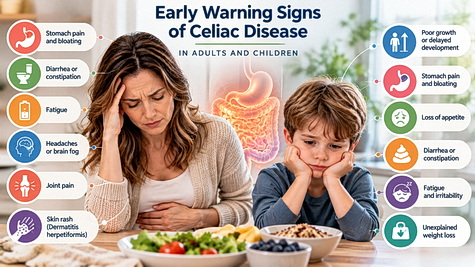

Celiac Disease Symptoms and Early Warning Signs in Adults and Children

Portriat of Staci Leibson

Published ​September 26, 2026

Author: Staci Leibson – Life Coach at The Celiac Shift

What Are the Early Warning Signs of Celiac Disease?

Illustration of Early Warning Signs of Celiac Disease

Common early warning signs of celiac disease in adults and children can include digestive symptoms, fatigue, headaches, skin problems, changes in appetite, and growth or weight concerns (AI image – does not depict real people) 

Early warning signs of celiac disease can include ongoing bloating, diarrhea or constipation, belly pain, fatigue, anemia, mouth ulcers, and an itchy, blistering rash; children may grow slowly or lose weight. The Celiac Shift reminds families to talk with a doctor before going gluten-free, because the diet can affect test results.

Digestive Symptoms

Digestive symptoms of celiac disease can include bloating, gas, chronic diarrhea, constipation, nausea or vomiting, belly pain, and loose, greasy, bulky, bad-smelling stools. Because these same signs also show up with problems like irritable bowel syndrome and lactose intolerance, doctors do not diagnose celiac disease from symptoms alone, as the National Institutes of Health explains in its overview of how celiac disease is diagnosed.

Symptoms Beyond the Digestive System

Celiac disease can also cause symptoms in other parts of the body, such as tiredness, headaches, joint or bone pain, depression or anxiety, balance problems, numbness or tingling in the hands or feet, and fertility or menstrual problems. Most people have one or more symptoms before they are diagnosed, and symptoms can come and go, so the full symptom list from the National Institute of Diabetes and Digestive and Kidney Diseases (NIDDK) is worth reading if several of these sound familiar.

Signs a Doctor or Dentist May Notice

Some warning signs show up at a checkup rather than as something you feel, including anemia or unexplained low iron, vitamin B12, or folate on a blood test, and tooth enamel defects or canker sores that a dentist may notice. UK clinical guidelines from NICE list unexplained iron, vitamin B12, or folate deficiency and severe or persistent mouth ulcers among the reasons to offer celiac blood testing.

Signs in Babies and Children

Digestive symptoms are more common in children than in adults, and because growing bodies need nutrients, celiac disease in children can also show up as slow growth or short height, poor weight gain or weight loss, delayed puberty, damaged enamel on permanent teeth, and mood changes such as irritability. Parents can compare what they see with the childhood symptom list from NIDDK, and the Celiac in Children and Teens section of our Complete Guide to Celiac Disease looks at how the condition affects growth, energy, and school life.

An Itchy, Blistering Rash Called Dermatitis Herpetiformis

Dermatitis herpetiformis is an itchy, blistering skin rash tied to celiac disease that usually appears on the elbows, knees, buttocks, back, or scalp, and some people have the rash with no other symptoms. It is more common in adults than in children with untreated celiac disease, and NIDDK notes that a doctor may take a small skin sample, called a skin biopsy, from a rash that could be dermatitis herpetiformis.

Celiac Disease With No Obvious Symptoms

Some people with celiac disease have no symptoms at all, yet untreated celiac disease can still lead to complications over time. The Celiac Disease Foundation explains that how strong symptoms feel does not necessarily reflect how much damage is happening in the intestine.

Family Members and Other Higher Risk Groups

You are more likely to develop celiac disease if someone in your family has it, and it is also more common in people with Down syndrome, Turner syndrome, or Williams syndrome. NIDDK advises blood relatives of people with celiac disease and people with type 1 diabetes to ask their doctor whether they should be tested, and UK guidelines from NICE go further by recommending that testing be offered to all first-degree relatives, meaning parents, siblings, and children.

When Symptoms Come Back After a Diagnosis

Symptoms typically improve on a gluten-free diet but may come back after eating even small amounts of gluten, and the dermatitis herpetiformis rash can return the same way. If familiar symptoms reappear, tell your doctor and look for hidden gluten at home with our guide on how to prevent gluten cross-contact in a shared kitchen.

What to Do If You Notice These Signs

If you notice these signs in yourself or your child, keep eating gluten and talk with a doctor, because doctors do not recommend starting a gluten-free diet before testing, and the diet can affect test results. The Diagnosis and Testing section of our Complete Guide to Celiac Disease outlines how celiac testing works.

Support After a Diagnosis

Celiac coaching is non-medical support that helps individuals and families turn a confirmed diagnosis into safe daily routines at home, at school, and when eating out. It does not replace your gastroenterologist or dietitian, and you can learn more about how celiac coaching works or book a free consultation with Staci Leibson.

Frequently Asked Questions

Can celiac disease be diagnosed in adulthood?

Yes. Celiac disease affects both children and adults, and some people are first diagnosed as children while others are not diagnosed until adulthood.

Is celiac disease the same as gluten sensitivity or a wheat allergy?

No. Gluten sensitivity can cause similar symptoms, such as belly pain and tiredness, but it does not damage the small intestine. A wheat allergy is a food allergy that can cause different symptoms, such as itchy eyes or trouble breathing, and it also does not cause long-term damage to the small intestine.

H3  Can a baby be tested for celiac disease before eating gluten?

UK clinical guidelines advise against celiac blood testing in infants before gluten has been introduced into the diet. Ask your pediatrician about the right timing if celiac disease runs in your family.

How common is celiac disease?

Experts estimate that about 1 percent of people worldwide have celiac disease, or about 2 million people in the United States, and many people who have it have not been diagnosed.

This page is general education written by a non-medical celiac coach and built from public health and clinical guideline sources listed at the end. It cannot diagnose celiac disease or replace care from a doctor.

Hidden Sources of Gluten Cross-Contact at Home

Portriat of Staci Leibson

Published ​September 26, 2026

Author: Staci Leibson – Life Coach at The Celiac Shift

What Are the Hidden Sources of Gluten Cross-Contact at Home?

Five sources of gluten cross-contact that are easy to miss at home are reused pasta cooking water, hands and kitchen handles, flour in the air, wheat-based play dough, and lip or mouth products. The Celiac Shift helps families check each one, because every item on this list gives gluten a path into the mouth.

Most families who live with celiac disease start with the obvious fixes: a clean toaster, separate jars, a safe shelf in the pantry. Those basics are covered in How to Prevent Gluten Cross Contact in a Shared Kitchen (https://theceliacshift.com/how-to-prevent-gluten-cross-contact-in-a-shared-kitchen/). This page picks up where that guide stops, with five routes that sit outside the usual equipment list and tend to get missed even in careful homes.

A quick definition first. The Celiac Disease Foundation describes cross-contact as what happens when foods or ingredients come into contact with gluten, generally through shared utensils or a shared cooking or storage environment. For someone with celiac disease, the practical question is simple: can this gluten end up in my mouth?

Why Small Amounts Matter

In the United States, the FDA only allows a food to be labeled “gluten-free” if it contains less than 20 parts per million (ppm) of gluten. Parts per million is a way of measuring very small amounts: 20 ppm means 20 parts gluten in every million parts of food. The FDA chose that level because it is the lowest that can be reliably detected in foods using validated testing methods, and because most people with celiac disease can tolerate foods with very small amounts of gluten.

The 20 ppm line is useful at home because it gives you a way to judge research findings. When a study measures gluten above 20 ppm in a food that was supposed to be gluten-free, that food would not qualify for a gluten-free label.

1. Reused Pasta Cooking Water

Boiling does not make shared water safe. Beyond Celiac, a national celiac disease organization, puts it directly: gluten cannot be “killed off” or “disinfected,” so it is not safe to use the same water.

Research backs this up. In a study from the Celiac Disease Program at Children’s National Hospital, published in the journal Gastroenterology in 2020, researchers cooked gluten-free pasta in water that had already been used to cook regular wheat pasta. Every sample of gluten-free pasta cooked in that reused water tested above 20 ppm, with results ranging from 33.9 ppm to 115.7 ppm. Of the kitchen tasks the team tested, shared pasta water was the riskiest.

The same study found two things worth knowing:

  • Rinsing the contaminated gluten-free pasta under running tap water for 30 seconds brought gluten below 20 ppm. That is a helpful finding if a mistake has already happened, but it came from a small, preliminary study, and it is not a substitute for clean water.
  • Rinsing the pot with water after cooking regular pasta was as effective as scrubbing it with soap and water at preventing detectable gluten transfer. A pot that has been properly cleaned can be used again.

What to do: always start gluten-free pasta in fresh water. If someone in your home cooks regular pasta often, make “new water for gluten-free pasta” a house rule that everyone knows, not something the person with celiac disease has to remember alone.

2. Hands and Kitchen Handles

Touching gluten is not the problem by itself. According to the National Celiac Association, gluten cannot enter the digestive tract through skin contact. The risk is what happens next: touching a food with gluten and then touching your mouth.

Hands also leave gluten behind on the things they touch. Beyond Celiac describes a common scene: someone baking with flour-dusted hands wipes them quickly and opens the refrigerator, leaving gluten on the door handle. The next person to grab a snack from the fridge picks it up. As Beyond Celiac puts it, all handles in the kitchen can expose you to gluten.

What to do: add the refrigerator door and other kitchen handles to your regular wipe-down, especially after anyone bakes or makes sandwiches. Wash your hands before you eat, and teach kids with celiac disease to do the same, since hands are how gluten on a surface reaches the mouth.

3. Flour in the Air While Someone Bakes

Wheat flour does not stay in the bowl. When it is poured, sifted, or mixed, a fine dust rises into the air. Beyond Celiac notes that flour can stay airborne for 12 to 24 hours, depending on ventilation and how much flour was used.

The National Celiac Association explains why this matters: flour in the air can get into the nose, mouth, and throat and be swallowed into the digestive tract. For that reason, the association does not recommend that people with celiac disease breathe in flour, and it advises avoiding baking or other activities that send flour into the air.

What to do: if someone in your home bakes with wheat flour, the person with celiac disease should stay out of the kitchen while the flour is out, and should not be the one measuring or mixing it. Some families simply bake with gluten-free flour so the whole household can share the kitchen without the dust. For how to protect counters and open food from flour that settles afterward, see the flour guidance in How to Prevent Gluten Cross Contact in a Shared Kitchen (https://theceliacshift.com/how-to-prevent-gluten-cross-contact-in-a-shared-kitchen/).

4. Wheat-Based Play Dough

Play dough is not food, which is exactly why it gets overlooked. The Celiac Disease Foundation lists wheat-based play dough as a source of gluten because children may touch their mouths or eat after handling it.

What to do: The Celiac Disease Foundation suggests homemade play dough made with gluten-free flour as a safer alternative. If you buy play dough or craft dough, check the ingredient list, and do not rely on a “wheat-free” claim alone. The foundation notes that products labeled wheat-free are not necessarily gluten-free, because they may still contain spelt (a form of wheat), rye, or barley. Parents who have celiac disease themselves should apply the same caution when they play with or clean up after their kids.

Play dough also shows up at school, at friends’ homes, and at parties. Planning for those settings is covered in our School and Social Guide (https://theceliacshift.com/school-and-social-situation-guide/).

5. Lip Products and Anything Else That Goes in Your Mouth

The Celiac Disease Foundation lists lipstick, lip gloss, lip balm, and other cosmetics used near the mouth as possible sources of gluten, because they may be unintentionally swallowed. It also lists oral care and dental products among the items to check.

What to do: check the labels on anything you put on your lips or in your mouth, and contact the manufacturer when the label does not make the answer clear. Products that stay only on your skin or hair are a lower concern, since gluten has to be swallowed to cause a reaction in celiac disease. The exception is anything that ends up on your hands and then near your mouth.

A Quick Walk-Through Checklist

Use this list for a five-minute check of your home. It collects the “what to do” step from each section above.

Hidden source How gluten reaches you The fix
Reused pasta water Gluten from wheat pasta stays in the water Always start gluten-free pasta in fresh water
Hands and kitchen handles Gluten moves from hands to handles to your mouth Wipe handles often and wash hands before eating
Flour in the air Airborne flour is swallowed Stay out of the kitchen while wheat flour is in use
Wheat-based play dough Hands carry dough to the mouth Use homemade gluten-free play dough
Lip and mouth products Products near the mouth get swallowed Check labels or ask the manufacturer

Getting Help With Your Home

These five sources are easy to fix once you know to look for them. The harder part is building habits that the whole household keeps without being reminded. That is the work The Celiac Shift does with families: turning a celiac disease diagnosis into routines that hold up at home, at school, and in social settings. Coaching is non-medical and works alongside your gastroenterologist and dietitian, not in place of them. Learn more about what celiac coaching is or book a free consultation to walk through your own home.

Frequently Asked Questions

Aren’t toasters and shared jars the biggest hidden sources?

They are the ones most people have heard about, which is why this page focuses on the others. Toasters, shared condiment jars, colanders, cutting boards, and sponges are all covered in How to Prevent Gluten Cross Contact in a Shared Kitchen.

Do lotion, shampoo, and other skin products need to be gluten-free?

For celiac disease, the concern is gluten that is swallowed. The National Celiac Association states that gluten cannot enter the digestive tract through skin contact. Products used only on skin or hair are therefore a lower priority than lip products, as long as they do not end up on your hands and then in your mouth.

How to Prevent Gluten Cross Contact in a Shared Kitchen

Portriat of Staci Leibson

Published ​September 13, 2026; Revised May 31, 2026

Author: Staci Leibson – Life Coach at The Celiac Shift

How to Prevent Gluten Cross-Contact in a Shared Kitchen

Gluten cross-contact in a shared kitchen is prevented by controlling three things:
what gets stored where, which shared equipment traps gluten, and how consistently the household follows the same habits. Staci Leibson at The Celiac Shift will show you how to treat these as one system, since one missed step, like a shared jar, is enough to cause exposure.

Image of items that can be contaminated with gluten

Everyday kitchen items can become unexpected sources of gluten cross-contact in a shared kitchen.

What Is Cross-Contact?

Gluten cross-contact happens when a food that does not contain gluten touches a surface, utensil, or ingredient that has come into contact with gluten. It is different from the food safety idea of cross-contamination, which usually refers to bacteria. Cross-contact is about protein transfer, and for someone with celiac disease, even a trace amount from a cutting board, a shared toaster, or a used knife in a peanut butter jar can trigger an immune reaction. Cross-contact can happen at any point, from the store shelf to the pantry to the pan, but the home kitchen is where a family has the most control.

How Do You Prevent Gluten Cross-Contact in a Shared Kitchen?

Preventing this type of surface contact in a shared kitchen means separating storage, duplicating a short list of high-risk equipment, and standardizing the order food gets prepared in. At The Celiac Shift, families are coached on how to set up a dedicated celiac-safe zone as follows: Keep a second toaster, colander, and cutting board on hand. Cook the gluten-free dish first, and label shared items clearly. These habits work because they remove day-to-day decision-making, not because they require a second kitchen.

Setting Up a Dedicated Gluten-Free Zone

Pick one shelf, one section of the counter, and one area of the pantry specifically for gluten-free foods. Store these foods, such as flour, bread, crackers, and other foods above the gluten-containing items, never below them, so crumbs or flour cannot fall onto the safe foods and contaminate them. Keep gluten-free snacks in their own bin or basket rather than mixed in with everything else, so anyone in the house can grab something safely without having to ask.

The Equipment That Actually Needs a Duplicate

Most kitchen tools can be shared once they are properly cleaned, but a short list of items can trap gluten in ways that regular washing cannot fully undo, and these are worth having a second set.

  • Toaster: crumbs collect in the tray and on the heating elements, and a shared toaster is one of the most common sources of accidental exposure. Buy a second toaster, or use toaster bags as a lower-cost stopgap.
  • Colander: the mesh holes hold onto starch and gluten particles even after washing. A dedicated gluten-free colander is a low-cost fix.
  • Wooden cutting boards and spoons: wood is porous, and gluten can work into small grooves and scratches that a sponge cannot reach. Plastic or glass boards that are dedicated to gluten-free prep are safer than trying to fully clean a shared wooden one.
  • Nonstick pans with scratches: scratches in nonstick coating behave the same way as grooves in wood. A pan reserved for gluten-free cooking avoids the guesswork.
  • Condiment jars used with a knife: butter, mayonnaise, jam, and peanut butter jars are a frequent hidden source, because a knife that touched bread and then went back into the jar contaminates the whole container. Squeeze bottles, or a labeled gluten-free jar that never gets a “bread knife,” solve this.

Pots, pans without scratches, glass and ceramic dishes, and stainless steel utensils can generally be shared as long as they go through a full wash between uses.

Cooking Order and Prep Technique

When gluten-free and gluten-containing meals are made back to back in the same kitchen, prepare the gluten-free dish first, while surfaces and hands are clean, and set it aside before starting anything with gluten. Use separate cutting boards for gluten-free ingredients during that prep, and wash hands after handling flour, bread, or pasta before touching anything gluten-free. If flour is used in the kitchen for baking or dredging, treat it like a contamination event: flour dust can settle on nearby counters and into open containers, so gluten-free items should be covered or moved to another room while flour is out.

Cleaning Surfaces the Right Way

A regular wipe down is not always enough to remove gluten protein from a surface. Countertops, stovetops, and shared cutting surfaces should be washed with hot, soapy water and a clean cloth or paper towel rather than a sponge, since sponges hold onto gluten particles and can reintroduce them to a surface that was just cleaned. Dish towels used to dry gluten-containing dishes should not be used to wipe down gluten-free prep areas.

Label Everything Clearly

A simple labeling system removes the need for anyone in the household to guess. Mark gluten-free items in the pantry and fridge with a sticker, a marker, or a dedicated color, and keep non-gluten leftovers in containers that look different from everything else. This matters as much for guests and extended family cooking in the kitchen as it does for the household itself.

Getting the Whole Family on Board

The systems above only work if everyone in the household follows them, not just the person with celiac disease. Walk family members through where the dedicated zone is, which equipment is off limits for gluten containing food, and why a “quick rinse” is not the same as a full wash. Framing the rules around safety rather than restriction, and involving kids in age-appropriate parts of the system, tends to get better long-term buy-in than rules handed down without explanation.

Common Hidden Sources of Cross-Contact

Even in a well-organized kitchen, a few less obvious sources of cross-contact can be easy to overlook. A wet spoon may find its way into a shared spice container, bread crumbs can linger on a cutting board, pet food or treats may be stored too close to human food, and torn foil can expose food to residue on a reused baking sheet. Every so often, take a closer look around your kitchen for these easy-to-miss trouble spots. Learn more about the hidden sources of gluten cross-contact at home and practical ways to reduce the risk.

Frequently Asked Questions

Do I need a completely separate kitchen to be safe?
No. A shared kitchen can be made safe with a dedicated storage zone, a short list of duplicated equipment, and consistent cleaning and prep order. A second kitchen is not required.

Can wooden cutting boards ever be used safely for gluten-free food?
A wooden board used exclusively for safe food preparation is fine. If it has previously been used for wheat, barley, or rye products, particles can remain trapped in surface grooves and scratches. For that reason, it is safer to dedicate a separate board to celiac-safe food preparation going forward.

Is a quick rinse enough to clean a shared pan?
No. A full wash with hot, soapy water is needed. A rinse alone does not reliably remove gluten protein from a cooking surface.

What is the single highest risk item in most shared kitchens?
The toaster and shared condiment jars are the two most common sources of accidental exposure, because both involve repeated contact points that are easy to overlook.

How is this different from what a dietitian would cover?
A registered dietitian manages clinical nutrition and deficiencies. A celiac coach at The Celiac Shift focuses on the daily systems, like kitchen setup and family routines, that make the diagnosis workable in real life. For a full walkthrough of how coaching supports a newly diagnosed family, see our Complete Guide to Celiac Disease.

If cross-contact concerns extend beyond the home, the NYC Gluten Free Restaurant Guide covers dining out, and the School and Social Guide covers lunchroom and classroom safety. Families who want a structured, one-on-one walkthrough of their own kitchen can book a free consultation.

Living With Celiac Disease: A Complete Gluten-Free Guide

Portriat of Staci Leibson

Published ​September 20, 2026

Author: Staci Leibson – Life Coach at The Celiac Shift

DIsplay of foods on a kitchen counter

A variety of naturally gluten-free foods can form the foundation of a healthy gluten-free lifestyle for people with celiac disease.

What is Celiac Disease and How is It Managed?

Celiac disease is a chronic immune disorder in which eating gluten, a protein in wheat, barley, and rye, damages the small intestine. It is diagnosed with blood tests and usually a biopsy, and treated with a strict, lifelong gluten-free diet. The Celiac Shift helps adults and families turn that diet into safe daily routines.


Symptoms and Early Warning Signs

Symptoms vary widely and can include bloating, diarrhea, fatigue, headaches, anemia, and an itchy skin rash, while some people have no symptoms at all. Learn which celiac disease symptoms and early warning signs to watch for in adults and children.

Diagnosis and Testing

Doctors typically diagnose celiac disease with a blood test followed, in most cases, by a small intestine biopsy, and you should keep eating gluten until all testing is finished. Our guide to how celiac disease is diagnosed walks through each test and what the results mean.


Gluten-Free Living Guide

Gluten is found in wheat, including spelt, durum, and semolina, as well as barley, malt, rye, and triticale, and it also hides in many processed foods such as soups, sauces, and candy. Reading every label and building meals around naturally gluten-free foods such as meat, fish, fruits, vegetables, rice, and potatoes are the foundation of a safe diet.


Preventing Cross-Contact 

Cross-contact happens when gluten-free food touches gluten while it is processed, stored, prepared, or served, and it can make otherwise safe food unsafe. Our step-by-step guide to preventing gluten cross-contact in a shared kitchen shows how to set up a safer home kitchen.


Safe Ingredient and Product Lists

People with celiac disease depend on accurate gluten-free ingredient lists, pantry guides, and safe product recommendations. Our detailed page includes verified ingredients, unsafe foods, and tips for choosing packaged products safely.


Dining Out and Travel

Eating out safely starts before you arrive: check menus online or call ahead, then tell your server you have celiac disease and ask how your food is prepared. New York City diners can download our free NYC Gluten-Free Guide for vetted restaurants and ordering tips.


Nutrition and Supplementation

Celiac disease can lead to low levels of iron, vitamin D, calcium, folate, and vitamin B12, and doctors often check these after a diagnosis. A registered dietitian can help you plan a balanced gluten-free diet and decide whether supplements are needed.


Celiac in Children and Teens

Celiac disease can affect a child’s growth, energy, and digestion, and school lunches, parties, and sports add everyday challenges. Our free School and Social Guide helps parents plan for meals and events away from home.


Celiac Resources, Tools, and Checklists

Managing celiac disease becomes easier when you have practical resources to guide everyday decisions. Explore checklists, planning tools, food and kitchen guidance, and other resources designed to make gluten-free living easier to navigate.

Support After a Diagnosis

Celiac coaching is non-medical support that helps adults and families turn a doctor’s diagnosis into safe routines at home, at school, and when eating out. Staci Leibson works alongside your gastroenterologist and dietitian, and you can book an appointment to get started.

The content on The Celiac Shift is for general informational and educational purposes only and is not medical, nutritional, or dietary advice. It is not a substitute for diagnosis or treatment by a qualified healthcare professional. Always consult your physician or a registered dietitian before making changes to your diet or health care, especially if you have celiac disease, gluten sensitivity, or food allergies.

Certain images, graphics, and illustrations on this website may be created or enhanced using artificial intelligence (AI). These images are used for illustrative and informational purposes and may not depict actual people, clients, employees, locations, events, or services performed. AI-generated images are not intended to represent actual customer experiences, testimonials, or documented results unless expressly stated otherwise.