Safe Gluten-Free Foods and Ingredients for Celiac Disease

 |
Published November 15, 2026 Staci Leibson – Life Coach at The Celiac Shift |
What Foods Are Safe to Eat with Celiac Disease?
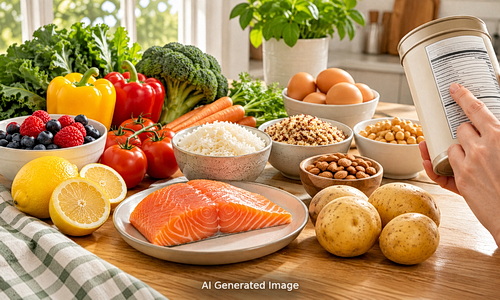
Finding the right gluten-free foods is essential
People with celiac disease can eat naturally gluten-free foods such as plain meat, fish, fruits, vegetables, rice, and potatoes, and must avoid wheat, barley, rye, and ingredients made from them. The Celiac Shift suggests checking every packaged label because gluten-free foods must contain less than 20 parts per million of gluten.
This page is the food and ingredient companion to Living With Celiac Disease: A Complete Gluten-Free Guide. It sorts everyday foods into three groups, lists the ingredient names that signal gluten, and walks through a food label in a set order. The Celiac Shift provides non-medical coaching, so use this page alongside advice from your doctor and a registered dietitian.
Three Groups for Any Food: Safe as Is, Check the Label, Avoid
Start by placing each food into one of three groups.
| Group | What belongs here | Why |
| Safe as is | Plain meat, poultry, fish, eggs, fruits, vegetables, beans, nuts, seeds, rice, potatoes, and dairy products | These foods are naturally gluten-free when nothing has been added to them. |
| Check the label | Soups, sauces, marinades, condiments, salad dressing, candy, ice cream, hot dogs, sausages, oats, and seasoned or boxed versions of plain foods | These foods often contain gluten or can pick it up during processing. |
| Avoid | Bread, pasta, baked goods, baking mixes, and cereals made from wheat, barley, or rye, plus beer, ale, lager, and malt beverages | These are made from gluten-containing grains unless a gluten-free version is clearly labeled. |
Naturally Gluten-Free foods
The National Institute of Diabetes and Digestive and Kidney Diseases (NIDDK) lists meat, fish, fruits, vegetables, rice, and potatoes as naturally gluten-free when they contain no additives or certain seasonings. MedlinePlus, from the National Library of Medicine, adds poultry, eggs, beans, nuts, seeds, and dairy products. Plain versions are the starting point. Once a food is breaded, marinated, sauced, or sold in a seasoned mix, it moves to the check the label group.
Gluten-Free Grains, Starches, and Flours
Flour made from potatoes, rice, corn, soy, nuts, cassava, amaranth, quinoa, buckwheat, or beans is safe to eat, according to the NIDDK. Buckwheat is on that list even though its name includes the word wheat. MedlinePlus also lists millet and cornmeal. Cross-contact, which is gluten spreading to a gluten-free food, can happen while foods are grown, processed, or stored, so choosing packaged grains and flours that carry a gluten-free label is the cautious option.
Are Oats Safe?
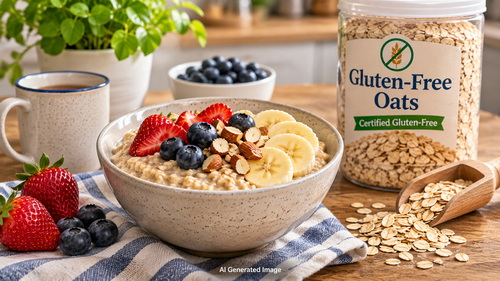
According to the NIDDK, most people with celiac disease can safely consume moderate amounts of oats, provided they are labeled gluten-free
Oats need their own rules. The NIDDK reports that most people with celiac disease can safely eat moderate amounts of oats, but only oats that are gluten-free, because cross-contact between oats and gluten-containing grains is common. Under the FDA rule, oats labeled gluten-free must contain less than 20 parts per million of gluten. Ask your doctor or dietitian whether to include oats and how much.
Grains and Ingredients That Contain Gluten
Gluten is the protein found in wheat, barley, rye, and crossbreeds of those grains. These are the names to look for on an ingredient list.
| Grain | Names you may see on a label |
| Wheat | Durum, emmer, semolina, spelt, kamut, farina, graham flour, bulgur, couscous |
| Barley | Malt, malt extract, malt flavoring, malt vinegar, brewer’s yeast |
| Rye | Rye and triticale, which is a cross between wheat and rye |
The NIDDK also warns that colorings, flavorings, starches, and thickeners can be made from gluten-containing grains. Three ingredients cause the most confusion:
- Malt vinegar. The FDA says malt vinegar is fermented and not distilled, so it cannot be used in a food labeled gluten-free.
- Soy sauce. The FDA explains that whether soy sauce can be labeled gluten-free depends on its ingredients and how it is made. MedlinePlus advises buying only gluten-free versions.
- Wheat starch. The FDA allows wheat starch in a food labeled gluten-free only when the finished food contains less than 20 parts per million of gluten.
What Does a Gluten-Free Label Mean?
In the United States, the FDA gluten-free labeling rule gives one meaning to four claims: gluten-free, no gluten, free of gluten, and without gluten. A food carrying any of them must contain less than 20 parts per million of gluten. It also cannot include a gluten-containing grain, or an ingredient made from one that has not been processed to remove gluten.
- The claim is voluntary. A food can be gluten-free and still carry no claim.
- Wording matters. The FDA says shoppers should not assume that a product described only as made with no gluten-containing ingredients meets every requirement of the gluten-free claim.
- The limit is small for a reason. Our guide to hidden sources of gluten cross-contact at home explains why small amounts matter.
How to Read a Food Label for Gluten
Work through the label in the same order every time.
- Look for a gluten-free claim. Any of the four FDA wordings counts.
- Check for wheat. Wheat is a major food allergen, so FDA allergen labeling requires it to be named either in the ingredient list or in
a Contains statement. If wheat is named and the food is not labeled gluten-free, put it back. - Read the whole ingredient list for barley, rye, malt, and brewer’s yeast. Barley and rye are not on the list of major food allergens,
so a Contains statement will not point them out. - If a food labeled gluten-free lists wheat, look for the explanation. A federal regulation requires the label to state that the wheat
has been processed to allow the food to meet FDA requirements for gluten-free foods. - Treat advisory statements as extra information. Wording such as may contain wheat or made in a facility that also processes wheat is voluntary, and not every manufacturer uses it, so a label without one is not a guarantee. A food labeled gluten-free must still meet the FDA limit even when it carries an advisory statement.
- When you are unsure, leave it on the shelf or contact the manufacturer. That is the NIDDK’s advice.
- Repeat the check on every purchase. The FDA notes that a product’s ingredients can change at any time.
Foods the FDA Gluten-Free Rule Does Not Cover
Two parts of the store follow different rules.
Meat, Poultry, and Egg Products
The U.S. Department of Agriculture, not the FDA, regulates meat, poultry, and certain egg products. USDA guidance on allergen statements treats Contains statements on these foods as voluntary, although every ingredient must still appear in the ingredients statement. For hot dogs, sausages, and other processed meats, read the full ingredient list instead of looking for a Contains line.
Beer, Wine, and Spirits
Most alcoholic beverages are regulated by the Alcohol and Tobacco Tax and Trade Bureau. Under TTB Ruling 2020-2, a drink may be labeled gluten-free only if it would qualify under the FDA standard. Beer fermented from gluten-containing grains cannot use the claim. If such a beer says it was processed, treated, or crafted to remove gluten, the label must also say that its gluten content cannot be verified and that it may contain gluten. Spirits distilled from gluten-containing grains may be labeled gluten-free when the producer follows good manufacturing practices that keep gluten out of the final product.
A Grocery Store Checklist
- Fill most of the cart with plain foods from the safe as is group.
- Choose grains, flours, and oats that carry a gluten-free label.
- Turn every package over and read the ingredient list, not only the front.
- Compare nutrition panels on gluten-free breads, pastas, and snacks. The NIDDK notes that packaged gluten-free foods may be
higher in fat and sugar, and tend to cost more than the regular versions. - Keep a short list of products you have already checked and recheck them at each purchase.
For snack bars, our gluten-free protein bar guide applies these checks to one product type. Once the groceries are home, preventing gluten cross-contact in a shared kitchen covers storage and preparation, and creating a gluten-free home together covers sharing the shopping and label checks across the household.
Why This Page Does Not List Brand Names
Ingredients can change, and a published list of brands can go out of date without warning. The current label on the package and the manufacturer’s own published information are the sources to rely on. When The Celiac Shift mentions a specific product elsewhere on this site, treat it as a starting point and confirm the current label yourself.
When to Ask for Help
A registered dietitian can teach you to identify gluten when you shop, cook, and eat out, and can help you plan a balanced gluten-free diet. If you believe a food labeled gluten-free made you sick, contact your healthcare provider, keep the package, and report it to the FDA. For help turning these rules into household routines, learn about celiac coaching with The Celiac Shift, which is non-medical and works alongside your medical team.
Frequently Asked Questions
Is wheat-free the same as gluten-free?
No. Barley and rye also contain gluten, so a wheat-free food can still contain it. MedlinePlus states that wheat-free does not always mean gluten-free.
Is distilled vinegar gluten-free?
The FDA explains that distillation can remove gluten, so a properly distilled ingredient may be used in a food labeled gluten-free even when it started from a gluten-containing grain. Malt vinegar is different because it is not distilled.
Does a food have to be tested or certified to be labeled gluten-free?
No. The FDA rule does not require manufacturers to test, and it does not require third-party certification, although manufacturers remain responsible for meeting the rule. Certification logos are allowed when they are truthful, and the FDA does not endorse any particular certification program.
Are gluten labeling rules changing?
Possibly. On January 21, 2026, the FDA issued a request for information on gluten labeling and cross-contact covering rye, barley, and oats. The agency said it will use the responses to decide on future action. A request for information is not a rule change, so the rules described on this page apply until the FDA announces otherwise. This page was last checked in November 2026.